Emotions as Predictions
Definition
Emotions are predictions generated by the brain using an internal model informed by sensory data and past experiences.
Mechanism
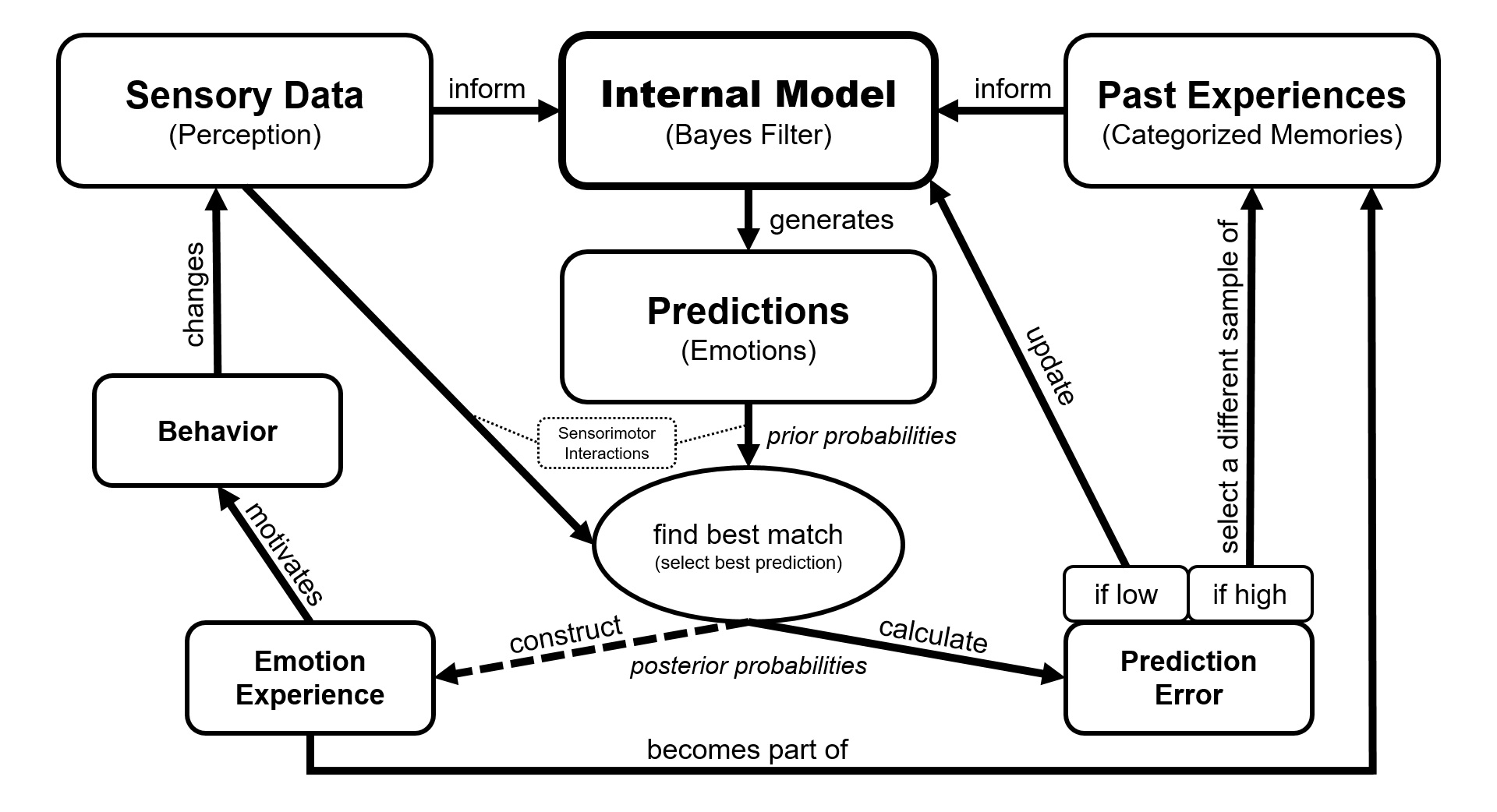
Explanation
Past experiences. All your emotions are shaped by your memories of the past, categorized by distinct emotion concepts, with an emphasis on your early childhood memories, as they tend to contain your most paradigmatic emotion episodes.
Sensory data. Emotions are situated, that is, embedded in an ever-changing environment. They dynamically depend on what you're perceiving in your exteroceptive physical and social environments as well as in your interoceptive physiological environment.
Internal model. With these sensory and memory inputs, your brain generates new emotion concepts by means of an internal model that functions as a Bayes filter and performs three operations:
- Categorize. Your brain asks, "What does the sensory data mean?" and categorizes the sensory input to create meaningful sensations. For example, a high heart rate alone doesn't mean much, but if you also feel yourself sweat, hear yourself stutter, experience muscle stiffness, and see a vast number of faces staring at you, your brain may classify that bundle of sensory data as "public speaking," roughly speaking.
- Combine concepts. Your brain asks, "What emotion categories, rooted in prior experience, best match these sensations?" and searches for functional similarities to combine potentially fitting emotion concepts in various ways. For example, your brain might find your current physiological profile to be similar to a past 'fear' experience, your current goals and desires to be similar to a past 'excitement' experience, and the nonverbal cues you get from the people around you to be similar to a past 'shame' experience. Accordingly, your brain may create conceptual combinations like (50% fear, 30% excitement, 20% shame), (60% fear, 10% excitement, 20% shame), etc.
- Create expectations. Your brain asks, "Given these conceptual combinations, what sensations are most likely to occur next and what behavior will be most beneficial in terms of supporting homeostasis and producing desirable sensations?" before it constructs competing predictions, a set of prior probabilities about what new sensations and motor actions are expected.
Brain. The brain is your central nervous system and seat of the internal model, involving constant communication between sensory, motor, and limbic areas.
Generated. Your brain doesn't retrieve static, discrete emotions from some emotional storage room. Instead, it continually and flexibly generates new emotion mixtures from conceptual combinations of current interoceptive data and past experiences. This implies that every single emotion you experience is unique.
Predictions. As produced by your internal model, predictions are ad hoc concepts that anticipate sensations and motor actions. When the brain then receives further sensory input, it compares these data to the competing predictions to find the best match between them. With the prediction that fits best, posterior probabilities and a prediction error are computed. The prediction error is the difference between anticipated and actual sensations. If it is low, your internal model can be updated directly. If the error is high, a different set of emotion concepts must be sampled from your memory to initiate a whole new emotional event. Emotional predictions minimize the prediction error through active inference by triggering physiological changes.
Emotions. Being predictions, emotions are active constructions rather than canned reactions. In less then a second, your brain categorizes sensations, combines concepts, generates predictions, calculates prediction errors, and updates your internal model. This process, which finetunes your model's predictions, may create many emotions before you actually have a conscious emotion experience. This conscious experience, however, is not epiphenomenal. Its role is to motivate high-level behavior, in contrast to the constantly ongoing sensorimotor interactions at the lower levels. In addition, the emotion experience is integrated into your past experiences so that it may become part of your future emotions.
Postscript
You may wonder why your brain does all that. What's the point of constantly trying to predict the future?
The answer is allostasis. Emotions anticipate what your body will need to maintain stability in order for these needs to be met as fast as possible. Reacting flexibly to changing needs is critical for survival, and if the body can make predictions to adapt quickly, even before needs arise, it saves a lot of energy.
In this sense, emotions are a physiological tool for optimizing energy efficiency in the body.
References
Hoemann K, Gendron M, Feldman Barrett L (2017). Mixed emotions in the predictive brain, Current Opinion in Behavioral Sciences, Vol. 15, pp. 51-57.